























Get ready for an amazing journey through the cosmos. We’ll share 10 fascinating facts about the universe. From the vastness of space to the mysteries of black holes, this article will explore the wonders beyond our planet. Prepare to be amazed by the scale and complexity of the space, galaxy, and cosmos around us.
If you love space or just find it interesting, these facts will grab your attention. They’ll make you appreciate our celestial home even more. So, get ready to explore the fascinating world of the universe!
The Vastness of the Cosmos
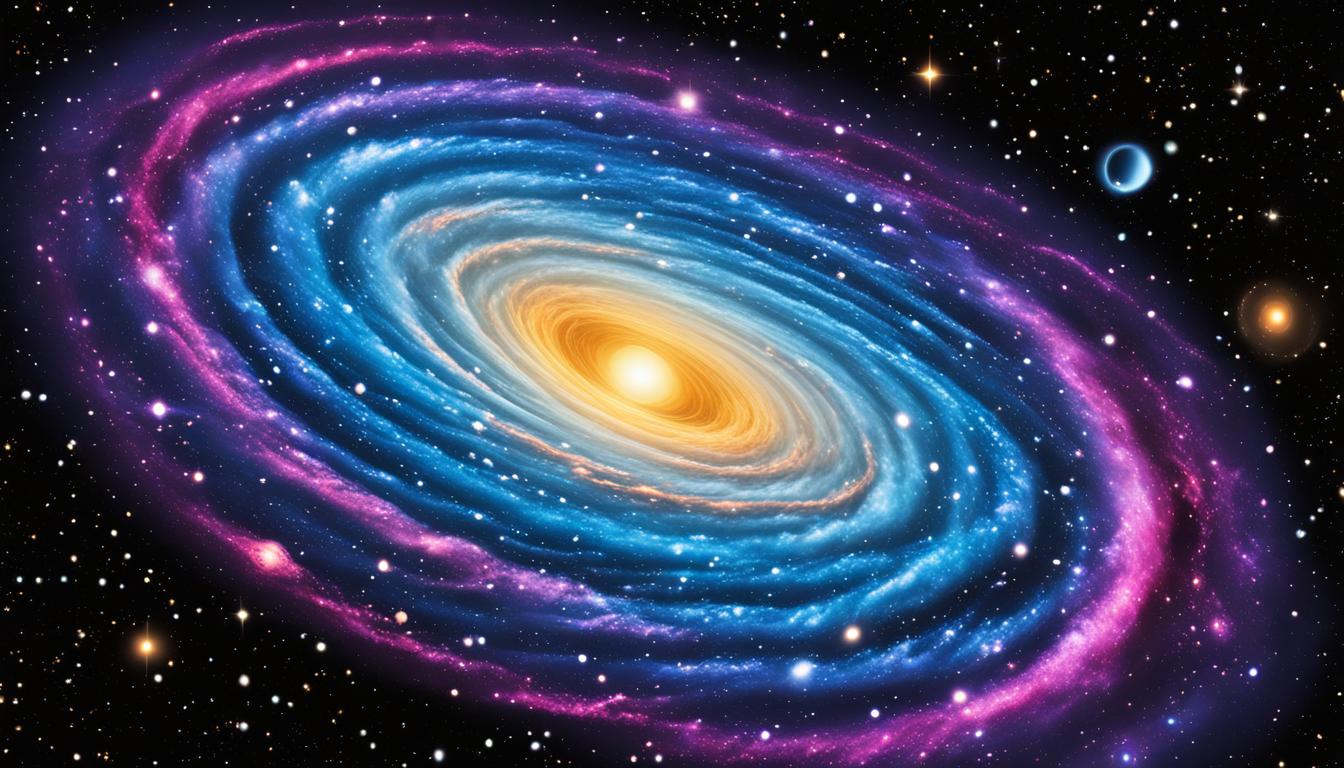
The cosmos is huge and awe-inspiring. Our understanding of it has grown a lot, showing us its size and complexity. Scientists say the universe has over 100 billion galaxies. Each galaxy has billions of stars.
Billions of Galaxies
Picture a huge cosmic ocean full of galaxies. These galaxies are like islands in space. They range from the small Milky Way to huge elliptical and spiral galaxies. Each galaxy has its own stars, planets, and black holes.
Expanding Universe
The universe is always getting bigger, with galaxies moving away from each other. This was first noticed by Edwin Hubble in the 1920s. As it expands, galaxies get farther apart, and light from far away turns red – this is called redshift.
The universe is incredibly big, and we’re still learning about it. With new technology, we’re discovering more about galaxies and the universe’s expansion. The cosmos is a never-ending source of wonder and study.
The Birth of the Universe
The cosmic origin story starts with the big bang. This massive event expanded space and time, creating our universe about 13.8 billion years ago. It was the beginning of everything we see today, as all matter and energy came from a hot, dense state.
The big bang theory says the early universe was a hot, dense mix of particles and radiation. As it expanded and cooled, the first stable atoms formed. This led to the creation of the first stars, galaxies, and the universe’s structure.
The origin of the universe is a mystery that captures our imagination. The big bang theory explains the universe we see, but the details of its creation are still unknown. Scientists worldwide are studying this to learn more.
From the big bang’s start to the first stars and galaxies, the universe’s birth was complex and dynamic. It shaped the cosmos we live in today. As we learn more about the universe’s origins and evolution, its creation story becomes more amazing and awe-inspiring.
The Hubble Deep Field
The Hubble Space Telescope has changed how we see the universe. Its Hubble Deep Field is a key achievement. It shows thousands of distant galaxies, giving us a peek into the early universe.
This image helps us understand how galaxies formed and changed over time.
Unveiling Distant Galaxies
In 1995, the Hubble telescope looked at a seemingly empty part of the sky for days. This let it catch the faint light from far-off galaxies. It showed a beautiful view of thousands of galaxies.
Some of these galaxies are over 13 billion light-years away. They let us see the universe as it was long ago.
The Hubble Deep Field has greatly helped us learn about galaxy formation and evolution. By studying these galaxies, scientists have learned about the universe’s early days. They’ve seen how the first stars and galaxies formed and how big structures like galaxy clusters developed.
After the Hubble Deep Field, more observations followed, like the Hubble Ultra-Deep Field. These looked even deeper into space, showing us even more distant galaxies. These studies have given us a lot of information about the early universe.
They help scientists understand how galaxies formed and changed over time.
Dark Matter and Dark Energy
The universe is full of mysteries, and dark matter and dark energy are two of the biggest. These unseen components make up over 95% of the cosmos. They puzzle astrophysicists and cosmologists a lot.
Dark matter is an invisible substance that pulls things together with gravity. It’s a key part of the universe’s puzzle. Dark energy, on the other hand, is a mysterious force that makes the universe expand faster.
The Invisible Majority
Scientists have known for a long time that most of the universe is not what we can see. Stars, galaxies, and planets make up just a small part of it. The rest is dark matter and dark energy, which we can’t see or understand well.
Dark matter doesn’t show up in light, so we can’t see it. But it’s crucial for forming galaxies and the big structures in space. Dark energy is even more mysterious. It makes the universe expand faster and faster.
Scientists are working hard to understand dark matter and dark energy. They use methods like gravitational lensing and particle physics experiments. As we learn more, we realize how important these mysteries are. They challenge what we thought we knew about the universe.
Fun Facts About the Universe
Get ready to be amazed by these cool and little-known facts about the universe. From the huge scale of the cosmos to the weird properties of black holes, these tidbits will make you see the universe in a new light.
The universe is so big that it would take a beam of light 100,000 years to cross the Milky Way galaxy. This fact shows how huge the universe is and how small we are in it. Also, a single teaspoon of material from a neutron star would weigh over 1 billion tons on Earth. That’s how dense these stars are.
The universe is always getting bigger. Astronomers found that it’s growing faster and faster, thanks to a mysterious force called dark energy. This growth started after the Big Bang, which happened over 13 billion years ago. The Big Bang was so hot, with temperatures over 10 billion degrees Celsius, hotter than the Sun’s core.
These fun facts and mind-blowing tidbits are just the start. As we keep exploring space, we’ll find even more amazing things about our universe.
The Big Bang Theory
The big bang theory is the top idea for how the universe started. It says the universe began as a super hot, dense spot. Since then, it has been getting bigger and cooler.
This big event started space, time, and everything and everyone in the universe.
The Origin of Everything
The universe began with a tiny, super dense point called the “singularity.” About 13.8 billion years ago, this singularity suddenly expanded and cooled. This led to the creation of the forces and particles we see today.
This event is known as the “birth of the universe” or the “origin of everything.”
The universe is still getting bigger, with galaxies moving away from each other. Scientists use cosmic microwave background radiation to understand the universe’s history. They can see how it changed from a hot start to the formation of stars and galaxies.

The big bang theory has been tested a lot and is widely accepted. It’s the main idea for how the universe began. As we learn more, the big bang theory stays a key part of understanding the universe.
The Cosmic Microwave Background
The universe is vast and full of mysteries. It has wonders that scientists and stargazers find fascinating. The Cosmic Microwave Background (CMB) is one such phenomenon. It’s a faint glow of radiation that fills the universe.
This radiation is from the early universe, around 380,000 years after the big bang. The discovery of the CMB in 1964 was a big deal. It helped prove the big bang theory, which explains how the universe began.
This radiation is like a snapshot of the universe when it was very young. By looking at the tiny changes in the CMB, scientists learn about the universe’s structure. They understand where matter and energy are spread out.
The CMB is full of secrets from the universe’s first moments. Finding it was a major breakthrough in understanding the universe. Studying it helps us learn more about our universe’s beginnings.
As we learn more about the cosmos, the CMB is key to our knowledge. It helps us piece together the story of the universe’s creation and growth.
Black Holes and Their Mysteries
The universe is full of amazing sights, and black holes are among the most fascinating. These areas of space have such strong gravity that nothing, not even light, can get away. They are thought to have gravitational singularities, where our current physics doesn’t work, raising big questions about space, time, and the universe.
At the center of a black hole is a gravitational singularity. This is a point where space’s curve becomes endless. Here, the laws we know stop working. Space and time inside a black hole get so twisted that they seem to switch roles, making it impossible to leave once you enter.
Things and energy pulled into a black hole get squished to incredible densities, ending at the singularity. This makes space-time curve infinitely, breaking classical physics. Scientists are trying to understand these gravitational singularities, pushing our knowledge of the universe.
Black holes and their secrets keep fascinating scientists and the public. These cosmic wonders show us the universe’s most extreme and mysterious parts. They challenge our grasp of the laws that rule the universe.
The Multiverse Theory
The idea that our universe is just one of many has fascinated scientists and the public. This theory, based on quantum mechanics and cosmology, changes how we see the universe. It opens new doors for exploration.
There could be an endless number of universes, each with its own laws and features. These universes, or “parallel worlds,” form a vast network. The laws of physics differ from one to another. Our universe is just a small part of a vast, complex cosmos.
The theory started with quantum mechanics, which studies tiny particles. It says every possible outcome of a quantum event creates a new universe. This means there could be countless realities, each unique.
This theory is still not proven but has sparked interest among scientists and the public. Researchers are looking into its implications. They hope it will change how we understand the universe and reality.

Exoplanets and the Search for Life
The discovery of exoplanets has changed how we see the universe. Astronomers have found thousands of these planets, some in the “habitable zones” of their stars. These zones could support life. The search for life on other planets has sparked our curiosity and drives us to explore the universe.
Habitable Zones
Habitable zones are where planets might have liquid water, key for life. Scientists look for exoplanets in these zones as they could support life. With new telescopes, we’re learning more about these planets and their potential for life.
Looking for exoplanets excites us all, making us wonder about life beyond Earth. As we learn more about space, finding life on other planets is a thrilling goal in astronomy.