


























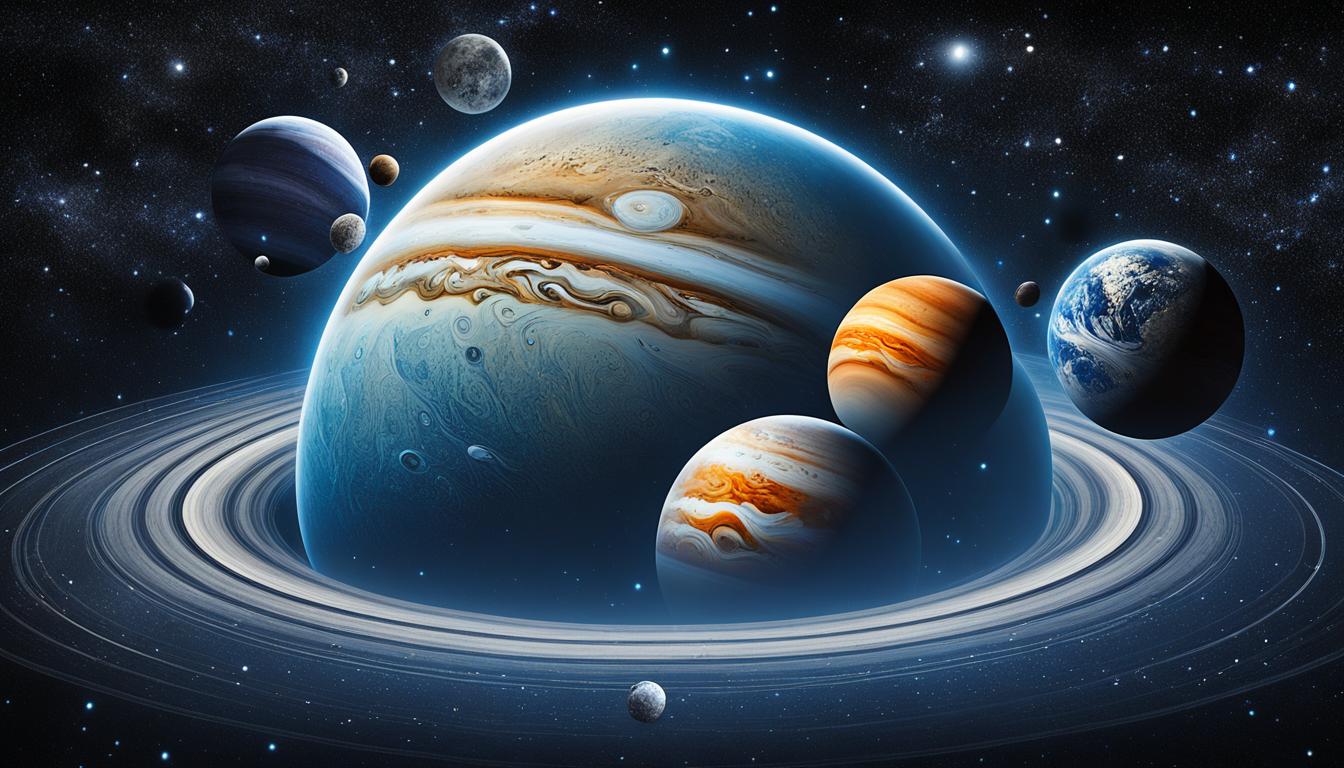
Get ready for a cosmic adventure filled with fun facts about our solar system! From the fiery Sun to icy dwarf planets, this article will take you on a journey. You’ll see the scale, diversity, and mysteries of our celestial neighborhood.
Our solar system is full of celestial bodies, each with its own story. Did you know the Sun is a huge ball of burning gas? It could fit over 1 million Earths inside it. Or that Neptune has winds up to 2,100 miles per hour, faster than any hurricane on Earth?
As we explore the solar system, we find planets from Mercury’s heat to Pluto’s ice. Each planet shows us the amazing processes that shape our universe. They challenge our understanding and push space exploration forward.
Exploring the Cosmic Wonders of Our Solar System
Our solar system is vast and full of wonders. It’s filled with celestial bodies that scientists and space fans love to study. From the Sun at the center to the icy dwarf planets at the edge, each object has its own story. Let’s explore the mysteries of space and see the amazing diversity in our cosmic neighborhood.
A Vast Playground of Celestial Bodies
Exploring our solar system is like going on a journey through a world of wonders. We see everything from Mercury’s heat to Neptune’s cold. Each planet is a unique place that scientists and fans find fascinating. Let’s dive into the secrets of these cosmic wonders and enjoy the dance of the planets.
Unraveling the Mysteries of Space
Space is full of mysteries waiting to be solved. Let’s uncover the secrets of dwarf planets, asteroids, and comets. This journey of discovery shows us new things about space and inspires us to learn more. Each new finding opens up new possibilities, helping us understand the universe better.
The Majestic Sun: A Powerhouse of Energy
At the heart of our solar system, the sun shines brightly as a massive energy source. This huge star gives us the light and warmth we need to live. It also makes the planets move in their paths.
The sun is a giant among stars, with a diameter of about 1.4 million kilometers. That’s 109 times bigger than Earth. Its huge size shows its incredible power. Inside, it has nuclear reactions that make a lot of energy. This energy spreads out, warming and lighting our solar system.

The sun’s energy is amazing. It makes enough energy every second to power all people on Earth for millions of years. This energy comes as light and heat, which are key for life on Earth. Without the sun, our planet would be cold and lifeless.
The sun does more than just give us heat and light. Its gravity keeps the planets moving in balance. It also protects us from harmful space radiation and solar flares with its magnetic field.
In short, the sun is the star of our solar system, a powerhouse of energy. It supports and shapes our world. Its beauty and power show the amazing balance of our universe.
Fun Facts About the Planets in Our Solar System
Our solar system is a fascinating place, filled with diverse planets. It ranges from the hot Venus to the cold Neptune. Each planet shows us the amazing variety of environments and landscapes out there.
From Scorching Temperatures to Icy Realms
Venus is often called Earth’s twin but it’s much hotter, with temperatures up to 450 degrees Celsius. On the other end, Neptune is icy, with temperatures around -200 degrees Celsius. These extremes show how different the planets can be.
Unveiling the Diversity of Planetary Terrains
Looking at our solar system, we see a wide range of landscapes. Mars has huge volcanoes like Olympus Mons, while Mercury has deep canyons. Saturn’s moon Titan has a thick atmosphere and lakes of liquid hydrocarbon, making it very different from Earth.
Learning about the planets and their unique features is exciting. It makes us want to explore more. The variety in our solar system shows how amazing these planets are.
The Enigmatic Dwarf Planets: Pluto and Beyond
Our solar system has a group of fascinating worlds called dwarf planets. These include Pluto, which has changed how we see the solar system. They make us rethink what objects orbiting the Sun are considered.
Pluto was once seen as the ninth planet. But in 2006, it was called a dwarf planet. This change was big news, as Pluto had a special spot in many people’s hearts. The decision was made because Pluto is small and orbits with icy objects in the Kuiper Belt.
Redefining Our Understanding of the Solar System
Pluto’s new status helped us understand the solar system better. Dwarf planets like Pluto orbit the Sun but aren’t big enough to clear their orbits. This is different from the eight big planets that dominate their areas.
Other dwarf planets include Ceres, Eris, Makemake, and Haumea. These small worlds show us how diverse and complex our solar system is. They make us think differently about what a planet is.
Studying these dwarf planets helps us learn more about our solar system. We’ll keep discovering new things about them. These discoveries will give us a deeper respect for the amazing things in space.
Asteroids: Remnants of a Bygone Era
Asteroids are the leftovers from when our solar system was first forming. They are rocky bits that help us understand how planets came to be. They tell us about the early days of our solar system.
Asteroids come from the early days of our solar system, billions of years ago. They are pieces of the material that surrounded the young Sun. This material eventually turned into the planets we see today.
By studying asteroids, scientists learn about how our solar system began. These rocks help us understand the building blocks of planets. They show us what the early solar system was like.
Exploring asteroids helps us learn about the planets’ beginnings. They are like clues from the past. By looking at asteroids, scientists can figure out how planets formed and changed over time.
New discoveries about asteroids keep changing what we know about space. They make us rethink old ideas and learn more about our solar system. Asteroids are still a mystery but they could reveal more secrets about where we come from.
Comets: Celestial Wanderers with Spectacular Tails
Comets are some of the most captivating celestial bodies in our solar system. They are icy wanderers that go back to the early days of our solar system. As they move through space, they leave behind trails of gas and dust that amaze us.
Unraveling the Secrets of These Icy Visitors
Comets are made of ice, dust, and rocky bits. When they get close to the Sun, their icy centers melt. This releases gas and dust that forms their famous tails. These tails can be millions of kilometers long, making them a sight to behold in the night sky.
Comets are more than just beautiful to look at. They hold secrets about our solar system’s early days. By studying comets, scientists learn about the solar system’s history and the materials that formed our planets.

Comets move through the solar system under the influence of the Sun and planets. This creates a complex dance that scientists can study. By understanding comets and their tails, scientists can learn more about our solar system and how comets helped shape our planets and moons.
Fun Facts About the Moons of Our Solar System
Our solar system is not just about the planets. It’s also home to a wide variety of moons, each with its own special traits. From the huge Ganymede to the icy Enceladus, these moons are full of surprises.
Jupiter and Saturn lead the pack with 79 and 82 moons each. Some moons, like Titan and Europa, are especially interesting. They have qualities that scientists and space fans find fascinating.
Space missions focus on these moons to learn about our solar system’s past. They help us understand how our solar system came to be. For example, studying Enceladus and Europa tells us about their geology and oceans beneath the surface.
These moons keep us amazed and inspired. They teach us a lot about our solar system’s history and how it changed over time. Their unique features make them a key area of study and exploration.
The Search for Extraterrestrial Life
Our understanding of the universe is growing, making the search for alien life exciting and ambitious. Scientists are exploring the possibility of life beyond Earth. They are pushing the limits of what we know.
Pushing the Boundaries of Cosmic Exploration
The hunt for alien life is changing space exploration. Researchers use new technologies and methods to study the universe. They look for signs of life in distant worlds.
This search not only makes us curious about space but also changes how we see the universe. Astrobiology, which mixes biology, geology, and astronomy, leads this search. Scientists study what life needs to exist and analyze distant worlds for signs of life.
As we get better at exploring space, we might make big discoveries. These could change how we see our place in the universe.